The Substrate Series · 10 — Capstone
The real moat isn't the gear or the budget — it's how fast new capability slots into a system that already knows how to use it.
Position versus derivative
Nine posts in, the same shape has shown up nine times. Power separated from compute. Networking separated from compute. Management separated from compute. Roles separated from substrates. Routing separated from placement. Each separation is a leverage point — a place where one layer can change without dragging the others along.
The discourse around AI infrastructure consistently measures the wrong thing. It asks position questions — how much VRAM, how many tokens per second, what TFLOPS. Those are snapshots of static capability. They miss the property that actually compounds: the derivative — when a new model gets released, a card gets affordable, a workload changes, a research direction opens, how fast can you act on it?
For most operators the answer is "weeks to months," because every new capability requires rebuilding the layer below. For an operator with the architecture this series has been describing, the answer is closer to "hours to days," because the layer below is already declared and reusable. Velocity buys velocity. Each acted-on opportunity becomes new substrate the next opportunity can build on. The operator who can absorb new capability fast gets to act on more opportunities, and the gap between fast and slow compounds.
That property is what the rest of this post argues for, with receipts.
Ten weeks, as the timeline ran
The MirrorEthic lab went from "an idea and a free motherboard" to "a multi-node mesh running production inference, public artifacts, and a board upgrade staged and ready to drop in" in roughly ten weeks. (The board went in the following week, exactly as the architecture predicted — more on that below.) Here is the actual timeline, day by day, dates and dollars and parts as they happened.
February 2026. The lab doesn't exist. There's a Lenovo Legion laptop with a 5090, used for dev work. The Pi5 voice pipeline exists separately as a side project. No mesh. No MirrorForge. No out-of-band management. No substrate routing.
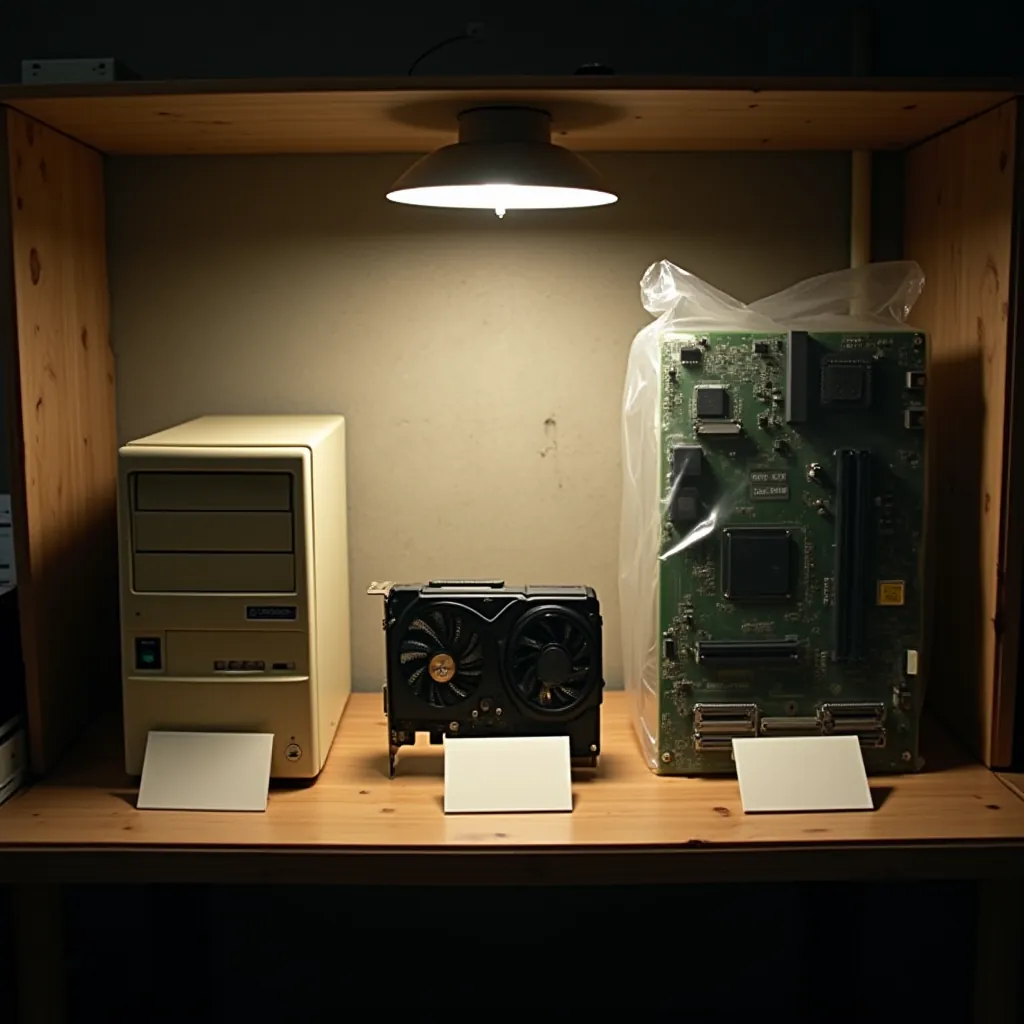
Mid-March 2026. Inherited a free GA-X99-UD3 motherboard, an old Xeon CPU, and a tower case from my mother's retired Photoshop PC. Bought thermal pads, Kryonaut Extreme paste, the first batch of Arctic S4028 fans. Began designing the buck-converter-on-veroboard power module for the V100 cooling.
March 26, 2026. First Tesla V100 16 GB arrived. $299.32 all-in. Began the thermal install and the war with the GA-X99-UD3's switchless lane allocation and missing Above 4G Decoding option.
March 27, 2026. V100 verified functional. FP16: 83.8 TFLOPS measured. ECC enabled, zero errors. MirrorForge is a single-V100 node, live.
March 28, 2026. Two fans per V100 wasn't enough for sustained load; upgraded to four. The cooling controller, on its own laptop brick and veroboard, absorbed the doubled fan count without anything on the compute side changing.
Early April 2026. Picontrol built. Pi Zero 2 WH in a small pressurized enclosure, USB-gadget piggyback to MirrorForge, Tailscale joined, mesh_monitor.py deployed. The out-of-band management plane went from "doesn't exist" to "operational and observing all four mesh nodes" in roughly a week.
Mid-April 2026. TB4 networking validated between Legion and ASUS. Direct ~10 Gb/s link via thunderbolt_net, no NIC purchase required. Role declarations for ASUS as the visual-perception substrate land at the same time.
Mid-to-late April 2026. The mesh registry pattern crystallizes. Per-node YAML files, role declarations, the cross-node coordination layer for pushing tasks between instances. Hologram-pro starts learning which files and memories are relevant to which kinds of queries on which nodes.
Early May 2026. First MCP servers exposed. SDXL on MirrorForge. T³ open-source release shipped same day as the r/MachineLearning ban — roughly 4 hours from "I'm going to convert this into something" to live artifacts at t3atlas.dev.
May 21, 2026. Won the second V100 on eBay. $304.67 all-in. Confirmed the conditional March plan. Power-wiring decision: dual-PCIe→EPS12V Y-adapters for both cards.
May 25, 2026. FLUX-dev wired up on MirrorForge via the GGUF Q4_K_S path. FLUX-fill turns out to run ~3× slower on Volta; the substrate-routing decision is made and the policy is drafted the same day.
May 26, 2026. Mesh-node-role-architecture-thesis crystallizes — the substrate-vs-role distinction the series is built around becomes the explicit operating model.
May 27, 2026. ASUS X99-WS/IPMI ordered to replace the GA-X99-UD3. $319.63 all-in. 10 GbE NIC pair staged for the MirrorForge↔Legion point-to-point. Boot drive cloned to a Samsung 990 2 TB via ddrescue over Thunderbolt 4 — verified bit-perfect, zero errors.
May 28, 2026. This series begins.
Velocity buys velocity, by the numbers
The numbers across that timeline are the evidence:
- First V100 install: weeks. War stories at every layer — IFR archaeology, Above 4G NVRAM edits, lane allocation diagnostics, BAR-window debugging. Two months of intermittent boot loops to fully stabilize.
- Second V100 install: an afternoon. The compute box was already designed for two; the cooling controller already had headroom; the power architecture already had a Y-adapter on the bench. The work was thermal paste, fan rewiring, plugging in the second EPS cable.
- Board upgrade (done): roughly fifteen minutes of physical work, and it went exactly as the role-and-substrate model said it would. Same socket, same RAM, same drives, same V100s, same case airflow. The OS didn't know it happened. The mesh didn't know it happened. The bots didn't know it happened. The X99-WS/IPMI has been in and running solidly since — and its IPMI has already earned its keep once, giving out-of-band recovery on a fault that the old board would have needed a human at the case to clear (that's post 06's story). Predicted fifteen-minute swap, delivered fifteen-minute swap.
- Mid-series Yellowstone week: zero operator time-cost. While the architecture was running ablation studies on MirrorForge and a 5B-token transfer run on Legion, I was a thousand miles away supervising from a Fold 6 and a $45 portable monitor (post 07 has the full setup). The research happened during the week, not in spite of it. The marginal time-cost of a week-long operator absence on a working architecture was zero, because the work was never on the operator.
That is what the derivative looks like as a measured quantity. Three capability additions — first V100, second V100, board swap — across ten weeks, each taking dramatically less time than the previous one. The reason isn't that the work got easier in some abstract sense; the reason is that each addition is operating on a substrate the previous additions had already laid down. Cooling architecture already there. Power module already there. Mesh routing already there. The marginal cost of the next addition gets smaller every time, because the addition isn't building infrastructure, it's populating infrastructure.
That property compounds across build cycles. The skill of getting a V100 working on used HEDT is the skill of getting any used datacenter card working on any used platform. The skill of wiring up a buck-converter cooling power module is the skill of any custom power module. The skill of writing 80 lines of FastAPI substrate-routing logic is the skill of any small routing service. Each piece of work pays itself off, and pays itself off again the next time something similar comes up.
The auto-mechanic model becomes the right shorthand here. A mechanic accumulates a workspace and skill over years. The workspace has tools that paid for themselves in the work they enabled. The skill compounds — every car worked on teaches something about the next one. Entry money is bounded (a starter set isn't a fortune), and the work is the moat. There is no gate keeping people out of the trade; there's an apprenticeship-shaped path, and the people who walk it become competent.
The MirrorEthic lab fits that shape exactly. The dedicated lab hardware on top of the laptops I'd own anyway — MirrorForge ~$1,363, Orin ~$250, Pi5 ~$120, picontrol ~$40 — is under $1,800 incremental. The two laptops (Legion ~$4,000, ASUS F15 ~$1,700) are general-purpose dev machines I'd have regardless of the lab; they're the bench, not the project. Counting them as "AI infra spend" would be like a mechanic counting the garage they already had against the cost of becoming a mechanic. They are the place the work happens, not the work itself. The honest number is under $1,800 in dedicated lab hardware — and the workshop is now capable of serving production inference, research training, public artifacts, and a small autonomous mesh.
The agent-operable capability — the differentiator nobody else has built
One forward-looking capability is worth naming at the end, because it's the cleanest example of the velocity argument applied to something that didn't exist when the lab started.
The mesh is agent-operable. As covered in posts 07–09, the cross-node coordination layer doesn't distinguish "operator at a terminal" from "operator via MCP." An MCP-capable model — Claude or any MCP client — can dispatch tasks to nodes, pull docs and telemetry, and act through the same routing primitive a human would, bounded by the same three-layer containment model (the MCP contract, per-node role scope, per-action permissions). The agent expresses intent; the orchestration layer places the work; the placement is scope-bounded.
That capability didn't exist in February 2026. It does now. It became possible because the architecture below it — the role declarations, the routing primitives, the security boundaries — was already there for other reasons. The agent-operable property fell out of an architecture that had been built for human operators, because the human operator's path and the agent operator's path turn out to be the same path. Velocity at work: when MCP-capable models became operationally useful, the lab could absorb them as a new class of operator without rebuilding anything below them.
That is the property the series has been arguing for, in its sharpest form. Most labs that exist today cannot slot in an agent operator without re-architecting their access surfaces, because their access surfaces were designed assuming a human at a terminal. The lab that was built around declared roles, scoped contexts, and a coordination fabric absorbs an agent operator as one more identity dispatching through the orchestration layer. The work that took most operators a research project takes the operator with the architecture about a configuration change.
This is the cleanest possible example of "new capability slots into a system that already knows how to use it." The architecture above the agent didn't move. The agent slotted in.
The convenience tax, paid honestly
A brief honest section to close on, because this series isn't an argument that everyone should build.
The convenience tax — renting cloud compute, buying pre-built systems, paying API rates — is the right trade for some operators. People with short-horizon projects where time-to-result matters more than ongoing cost. People with full-time jobs and small windows of work where the architecture lift would consume the work itself. People who don't enjoy hardware. People who'd rather pay in money than hours. I rent cloud compute too — the Thundercompute integration is the architecture-for-renting-when-the-mesh-is-saturated, and it slots into the same role registry as any other substrate.
What I do want to flag, because the live receipt landed this week as I was writing this series, is that the convenience tax is narrower than the marketing implies. Post 02 walked the full version of this point; the short version belongs here too as the capstone's honest close.
MirrorForge was offline for the board swap while I was assembling this series. I needed hero images; the local mirage MCP was unreachable. I fell back to gpt-image-1 and Imagen 4 — the hosted-API path that the convenience-tax framing is exactly about. Both worked. Both also produced exactly the artifact they were paid to produce: a single image per call, no iteration, no img2img, no inpaint, no outpaint, no upscale. The hosted-API path gave me the first ten percent of a production pipeline at a premium. The local stack — once MirrorForge came back on the new board — took those same images as raw material, finished them through Real-ESRGAN x4 upscale and the rest of the local production chain, and has run the same prompts end-to-end for free ever since. (Several of this series' images since then have been generated start-to-finish on those V100s — including the current hero of post 04, made on the very cards that post is about, now running 20 °C cooler under their fab-printed shrouds.) The $300 used datacenter card is the finishing stage that makes the $0.19-per-call frontier API output actually usable.
Hosted APIs win on text rendering inside an image, on certain kinds of unusual instruction-following, on one-shot-and-done with no GPU at hand. That's a real but narrow niche. Outside it, the premium path is the narrower path — and the receipt above is mine, from this week, with the gpt-image-1 outputs sitting on disk waiting for the local pipeline to finish them when MirrorForge comes back.
The choice isn't binary. The framing this series advocates is more specific: if you'd rather pay in hours than dollars, the architecture is learnable and the parts are purchasable. That's a choice for the people who want it. The people who don't are making a different rational trade — just with a clearer understanding of which path is actually the broader one.
The close
You do not build a homelab. You build a system that absorbs capability.